
Applications

Three application areas, one promise: simple, local hydrogen autonomy

1. Decentralised hydrogen gas consumption
Produce locally, when needed
The ElhyGas storage and generation unit produces hydrogen on site and on demand, without transport, permanent storage of pressurised gas or interruptions to supply.
Typical applications:
- Intermittent industrial use
- Sites with strict installation constraints
- Specialised applications (balloons and aerostats, alternator cooling)
- Medium-pressure needs (hydrogenation).
Why Elhytec?
- No gas delivery logistics
- Lighter regulatory constraints
- Improved safety through gas-free storage
- Better control of supply costs; suitable for sites without specialist maintenance capacity
- The option to replenish the storage when electricity is available
- Flexible, dependable operation, with on-demand output independent of the electrical power available at the time of use
→ Local, straightforward, safe and economical hydrogen tailored to your constraints.
Use Case : balloon and aerostat inflation for meteorology and surveillance
A configuration suited both to meteorological upper-air souding operations and to the inflation of tethered aerostats for surveillance and measurement.
The solution replaces H₂ or helium cylinders with straightforward, safe local production, providing:
- Guaranteed availability at launch time
- A substantial reduction in logistics costs and uncertainty
- Operation at remote sites
- Short inflation times
- Gas quality suited to buoyancy and repeatable measurements
- Greater operational discretion, with no visible gas supply chain.
Two possible configurations:
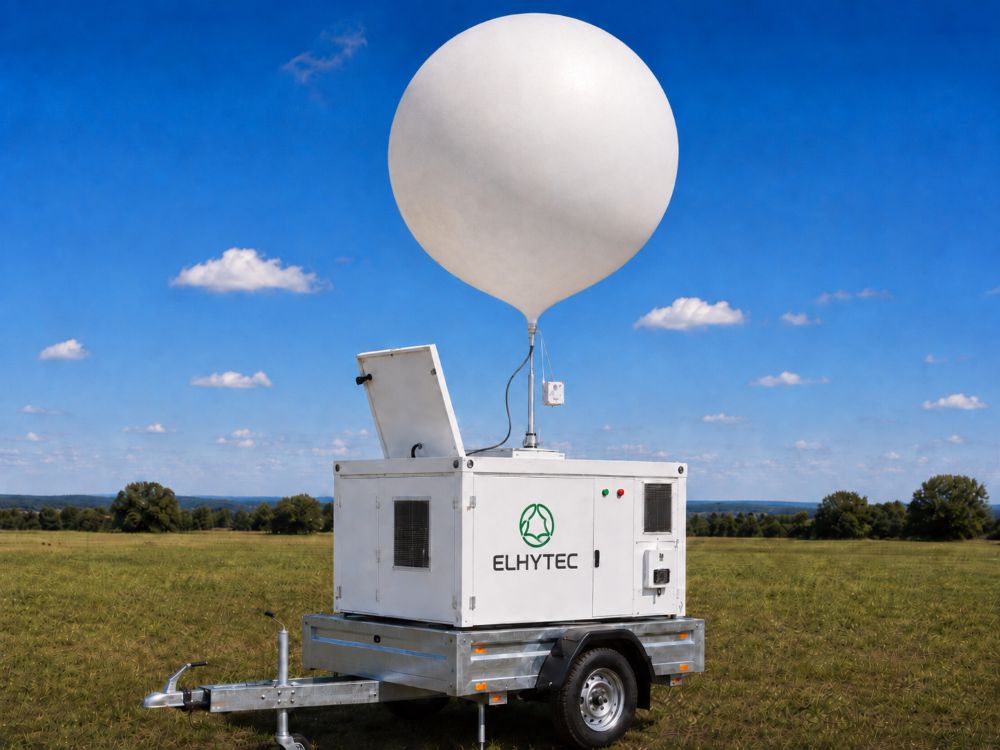
Transportable inflation station : on-demand hydrogen supply for field applications.
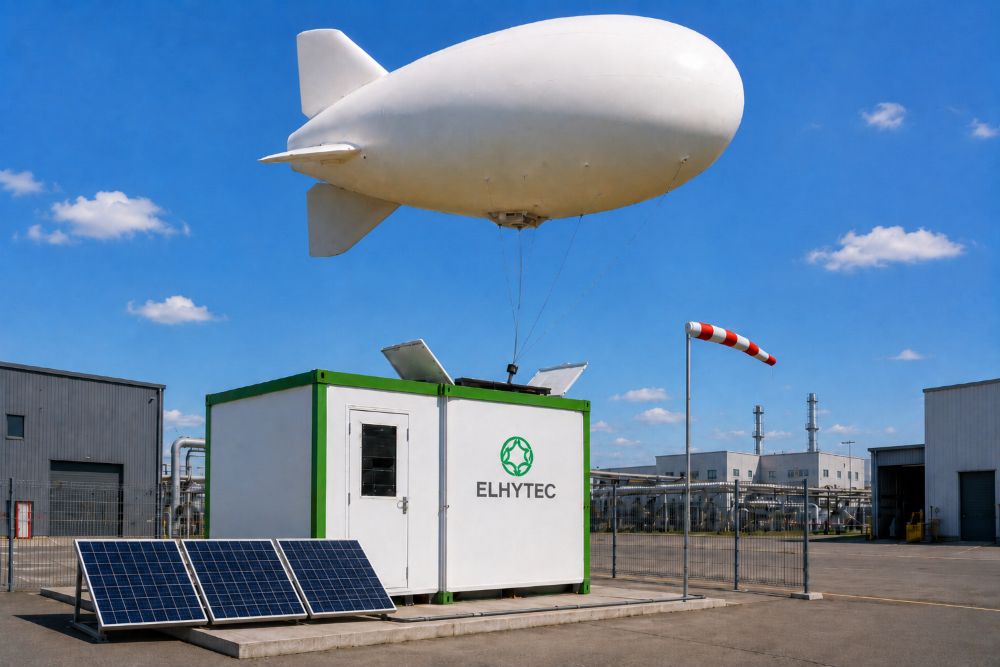
Stationary inflation station: on-demand hydrogen with continuity of operation for permanent sites and regular launches (training, fixed surveillance).
2. Energy storage for assured power supply
Elhytec’s technology meets the need for reliable, uninterripted power supply. Its simple, safe hydrogen storage solution supports fuel cells and hydrogen engines that provide clean electricity, while complementing lithium batteries with long-duration storage.
Typical uses :
- Backup power for critical sites (healthcare, telecom towers, data centers)
- Remote sites or tactical posts (mountain refuges, research bases, telemetry stations, solar microgrids)
- Turning intermittent or surplus electricity into value
- Storage over several months
Why the Elhytec solution?
- Long-duration autonomy
- Inherent safety: no stored gas, no pressure and no thermal runaway risk
- Low heat and noise signature, with no continuously operating combustion engine
- Flexible sizing to match the need: stored energy, charging power and discharge power can be configured independently
- Simplified electrolysis process architecture through decoupled oxygen and hydrogen evolution.
→ Clean, stable energy available wherever it is needed.
Securing electricity supply for a critical site or remote post
Example: backup for a telecom tower. A gas-free storage device and fuel cell replace a diesel generator. Decoupling allows an architecture suited to infrequent backup use, with a clean, competitive solution that reduces tied-up capital, maintenance and risk.
The same system can secure electricity for a remote operational post or site without the significant heat and noise signature of a diesel generator.
Typical specifications: 750 kWh storage (equivalent to 50 kg of H₂), 10 kW output, modular containerised format.
Access to pressurised hydrogen for critical missions
For long-endurance missions, hydrogen operates on a different scale: it delivers an endurance that batteries alone cannot achieve. In remote environments, the main constraint is not just energy, but the logistics of pressurised hydrogen, which is needed to compensate for the molecule’s low density.
Typical Use
- Refuelling long-endurance hydrogen-powered surveillance and reconnaissance drones.
Why Elhytec Solution?
- Hydrogen is produced directly at high pressure (350 bar), with no compressor
- The production unit is easier to move and deploy
- Rugged technology designed for field operations, with no fragile high-tech equipment
- Enhanced safety: no transport or storage of pressurised hydrogen gas.
→ A hydrogen solution designed for operational reliability and mission resilience.