Elhytec Innovation

"Decoupled water electrolysis"

The challenge
Hydrogen is complex to deploy:
- Its low density calls for gas compression or liquefaction.
- Its flammability characteristics (low ignition energy and a broad flammability range) demand specific safety systems.
Yet its main advantage is clear: it can be produced locally with low carbon emissions by electrolysing water.
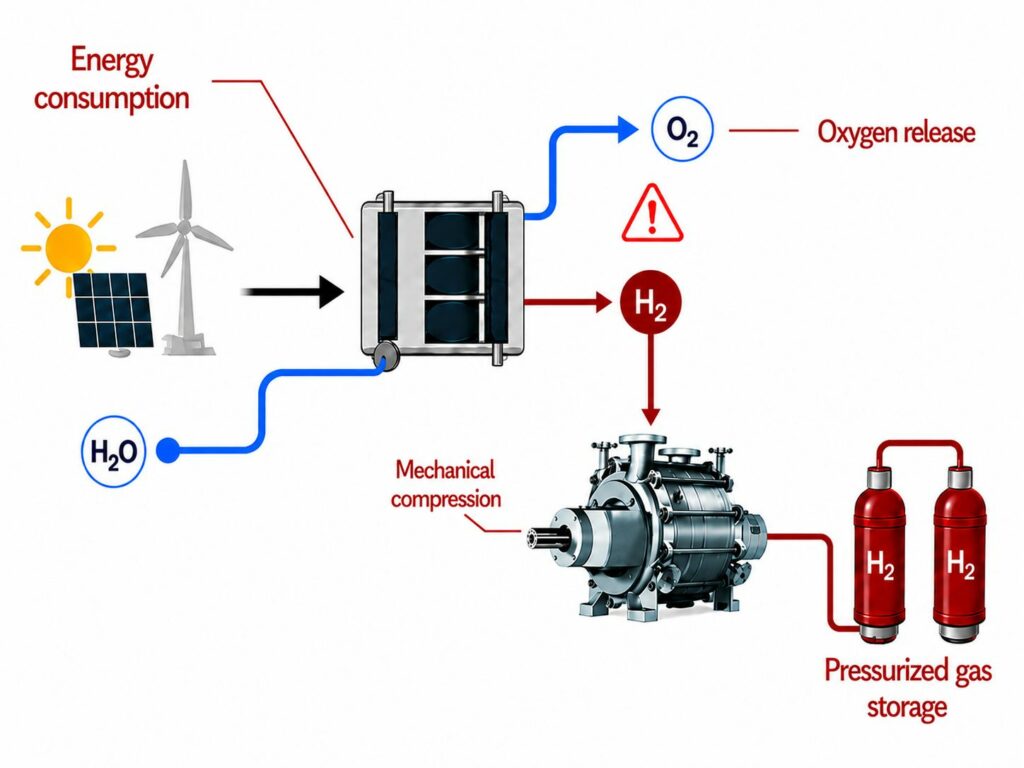
Conventional electrolysis, however, has a structural constraint: simultaneity.
- Electricity consumption and hydrogen production occur together.
- Hydrogen and oxygen are produced together.
This rigidity creates operational and economic limits:
- H₂ production follows available electricity rather than actual demand, requiring burdensome gas storage, either bulky or pressurised.
- Both gases must be managed together, increasing technical complexity, the risk of an explosive atmosphere, and investment costs (separation membrane, purification and two gas circuits), while limiting pressure.
- High capital costs drive a need for high utilisation, often incompatible with variable or opportunistic electricity.
- Limited ability to respond to intermittent power (start-stop operation and load following) or changing hydrogen demand.
Our answer: “Decoupled electrolysis”
Elhytec’s technology answers a simple question: how can these simultaneous processes be separated? The answer is decoupled water electrolysis.
How does it work?
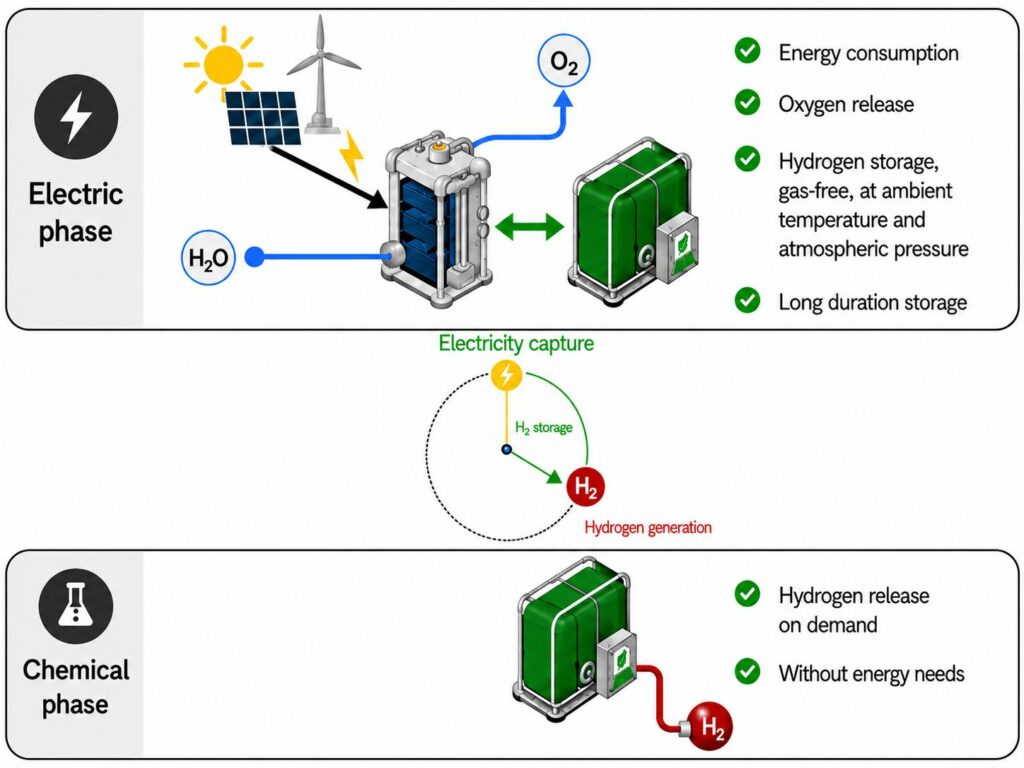
Water electrolysis is carried out in two distinct stages, with an intermediate storage stage between them.
1) Electrolysis
When electricity is available, electrolysis releases oxygen gas only and accumulates H⁺ ions, acidifying the electrolyte.
2) Storage
The electrolyte is kept at ambient temperature and pressure. It remains stable without self-discharge for periods ranging from a day to a year.
3) Hydrogen Generation Step
When required, hydrogen gas is generated from the store by catalytic activation, with no additional energy input. The system returns to its initial state, ready for another cycle once water and electricity are available.
Overall, the process splits water into oxygen gas in stage 1 and hydrogen gas in stage 3.
What are the benefits?
Inherent safety
- H₂ and O₂ cannot coexist in the production process.
- NNo storage of flammable gas, whether in large volumes or under pressure.
Lower cost
- No O₂/H₂ separation membrane in the electrolysis cell, avoiding fragile and costly components.
- No purification dictated by gas storage requirements, such as stringent moisture limits for high-pressure steel tanks. Gas quality can be tailored to the final application.
- No compressor: optional direct high-pressure hydrogen release through electrochemical compression, depending on the application.
- Opportunities to simplify the system, including partial sharing of gas circuits and DC/DC coupling.
Flexibility
- Adaptation to intermittent electricity through load following and start-stop operation.
- Adaptation to fluctuating hydrogen demand through full or partial discharge.
Simplified Deployment
- Not subject to certain onerous regulatory requirements, including French ICPE category 4715 for hydrogen storage.
- A closed cycle with no discharge or organic product.
With Elhytec, electricity is used when available and hydrogen gas is generated when needed.
How is it possible?
The cyclic decoupling of electrolysis relies on two capabilities: It is based on two core points:
- The formulation of the electrolyte chemistry.
- Control of catalytic activation of hydrogen evolution.
How is it implemented?
Elhytec has developed a hydrogen storage and generation module that uses the specific capabilities of decoupled electrolysis and the resulting simpler architecture:
- Independent sizing of three factors: electrical charging power, stored energy (hydrogen equivalent), and discharge power (hydrogen flow rate).
- Enhanced inherent safety against explosive atmosphere risks.
- Hydrogen delivery pressure initially limited to 16 bar, with scope to increase it for different applications.
- Proven, readily available industrial components in a simple modular architecture.
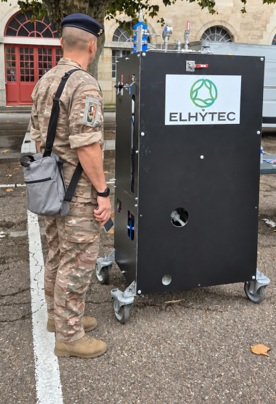
The absence of gas storage and a compressor also makes operation less conspicuous: no compression noise and no stored pressure to secure. Its robustness suits demanding environments. These benefits directly support balloon and aerostat inflation, low-signature power supply and drone endurance, as described on the Applications page.
The design can be adapted to each application: stationary or mobile systems, and separation in time and/or location.