Elhytec Innovation

"Decoupled water electrolysis"

Conventionnal technology: the challenge
Hydrogen is complex to deploy:
- Low density –> either gaseous compression or liquefaction.
- Reactivity –> specific safety layout.
Yet its key advantage is clear: hydrogen can be produced locally and decarbonized through water electrolysis.
However, conventional electrolysis is built around a structural constraint: simultaneity
- simultaneity between electricity consumption and hydrogen production,
- simultaneity between hydrogen and oxygen gas production.
This rigidity creates operational and economic limitations:
- H₂ production dictated by available electricity, regardless of real demand → constraining gas storage (large volumes or high pressure),
- Co-management of both gases → technical complexity, risk management, costs (separation, purification, dual circuits), limited pressure,
- High Capex→ need for high load factors, often incompatible with variable or opportunistic electricity,
- Limited electrical flexibility with intermittent power (stop & go, load following) and difficulty adapting to fluctuating H₂ demand.
Our answer: “Decoupled electrolysis”
Elhytec’s technology answers a fundamental question: how can we break this simultaneity?
The answer is “decoupled water electrolysis”.
How Does It Work?
Water electrolysis is performed in two distinct steps, creating a third intermediate storage stage.
1) Electrolysis Step
When electricity is available, electrolysis is carried out with oxygen gas release and accumulation of H⁺ ions (acidification of the electrolyte).
2) Storage Step
The electrolyte is stored at ambient temperature and pressure.
It remains stable without self-discharge from daily to yearly timescales.
3) Hydrogen Generation Step
When required by the application, hydrogen gas is generated from the stored electrolyte without additional energy input, through catalytic activation.
The system returns to its initial state, ready for a new cycle, awaiting water input and electricity availability.
Overall balance:
Water is decomposed into oxygen gas (step 1) and hydrogen gas (step 3).
What Are the Advantages?
Safety
- No coexistence of H₂/O₂
- No gaseous storage (volume or pressure)
Cost
- No electrolysis separation membrane
- Purification adapted to use, not to gaseous storage
- No compressor; high-pressure hydrogen release (depending on application)
- System simplification opportunities (partial gas circuit mutualization, DC/DC coupling)
Flexibility
- Compatible with intermittent electricity (load following, stop & go)
- Adapted to fluctuating hydrogen demand (partial or full discharge)
Simplified Deployment
- Not subject to heavy regulatory directives
- Closed cycle with no emissions, no organic products
With the Elhytec solution, electricity is consumed when available, and hydrogen gas is generated when demanded by the application
How is it possible?
Elhytec’s patented innovation enables this decoupling of electrolysis by fundamentally operating it in a cyclical mode.
It is based on two core points:
- the formulation of the electrolyte chemistry,
- the mastery of the catalytic activation of hydrogen release
How Is It Implemented?
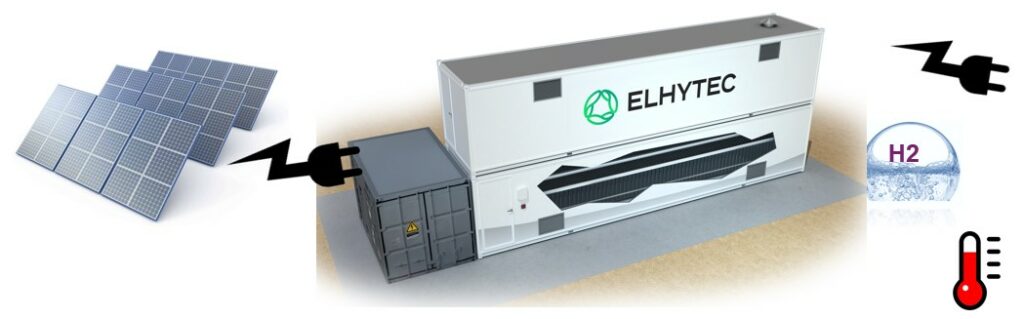
Elhytec has developed a hydrogen storage and generation module designed to leverage the specific functionalities of “decoupled electrolysis,” as well as the architectural simplifications that result from it:
- Independent sizing of the three key parameters: electrical charging power, stored energy capacity (hydrogen equivalent), and discharge power (hydrogen flow rate),
- Enhanced control with respect to ATEX risk,
- Hydrogen delivery pressure initially limited to 16 bar, with scalability depending on application requirements,
- Extensive use of proven, commercially available industrial components within a modular architecture.
This design provides a flexible foundation that can be adapted to different use cases: stationary or mobile systems, with temporal and/or physical decoupling.